
BJJ for teens is one of the best ways for a teenager to get fit, build real confidence, and learn to protect themselves without trying out for a team. With good supervision it’s a safe sport, and starting in middle school or high school is not too late. No experience is needed, just a willingness to show up.
Key Takeaways
- BJJ gives teens confidence they earn through real, measurable skill, with no tryouts and no bench.
- In a supervised class with controlled sparring and early tapping, jiu-jitsu is a safe sport for teenagers.
- Starting at 13, 15, or 17 is normal. Leverage and technique matter more than size or a head start.
- At Spartan Academy MMA, teens 15 and under train in the Youth BJJ program, and the first class is free.
Maybe your teen didn’t make the team this year and hasn’t found their thing since. Or maybe a friend keeps inviting them to try jiu-jitsu, but walking into a gym full of people who already know what they’re doing sounds terrifying.
Both are normal places to start. This guide is for parents, and for teens reading over their shoulder. It covers what Brazilian Jiu-Jitsu actually does for teenagers, how safe it is, and what classes look like at Spartan Academy MMA in Columbia, SC, under Head Professor Guybson Sá. Our youth program covers ages 8 to 15, and if your teen is 16 or 17, we’ll show you where they fit in, too.
Why BJJ works so well for teenagers
BJJ gives teens something rare at that age: a skill they can actually measure and a coach who notices when they get better. It works for athletes, and it works just as well for kids who never liked sports.
Confidence That Comes From Real Skill
Teen confidence is fragile because so much of it depends on what other people think. Jiu-jitsu builds a different kind. When a teen escapes a position that trapped them last month, nobody has to tell them they improved. They felt it.
That kind of confidence tends to show up in quiet ways, like a teen who stays steady when something goes wrong at school instead of letting it ruin the whole week.
A Sport With No Cuts and No Bench
There are no tryouts in BJJ and no sitting on the bench. Every student trains every class. A 14-year-old who got cut from the basketball team gets the same mat time and the same attention as anyone else in the room.
This matters more than parents sometimes realize. A lot of teens quietly decide they’re “not athletic” after one bad tryout. BJJ gives them a fresh start where progress depends on showing up, not on a coach’s roster.
Fitness That Doesn’t Feel Like a Workout
A BJJ class works the whole body: grip, legs, core, balance, and cardio. But teens rarely think of it as exercise. They’re focused on solving a problem with a partner, and the sweat just happens.
If you’re a teen who hates running laps, that’s the whole point. You keep coming back to something that feels like a game, and the fitness shows up on its own.
A Healthy Place to Put Stress
Between school and their phones, teens carry a lot. A hard hour on the mat is one of the healthiest outlets they can have, and it comes with a built-in break from the screen.
Don’t be surprised if your teen starts coming home tired and a little easier to talk to. A busy mind that gets an hour of full physical focus tends to settle down.
Self-Defense Built on Calm, Not Aggression
BJJ teaches teens how to stay calm when someone bigger is in their space. They learn to control a situation without throwing punches, and they learn it through practice, not theory.
The goal of self-defense training is never to go looking for a fight. Teens who know they can handle themselves usually feel less need to prove anything, which is exactly what most parents hope for.
Is jiu-jitsu safe for teens?
Yes, when it’s taught in a supervised class with clear rules. BJJ has no strikes to the head, and every technique is practiced with a partner who is there to help your teen learn, not to hurt them.
Like any contact sport, it isn’t risk-free. Bumps and sore muscles are normal, especially in the first few weeks. What keeps training safe is a coach who controls the pace and students who tap early, before a hold turns into a problem. For a deeper look at where injuries actually come from, read our guide on whether jiu-jitsu is dangerous and how to manage the risks.
At Spartan Academy, sparring in the youth program is controlled and supervised. Live rounds are a chance to practice what was taught that day, not a test of who is toughest.
Tapping Is the Safety System
Every student learns this on day one: when a hold gets uncomfortable, they tap their partner (or the mat) and everyone stops. No pride, no penalty. Good partners respect the tap instantly, and coaches watch for it.
For many teens, learning to tap is one of the first life lessons of jiu-jitsu. It teaches them that knowing your limits is a strength, not a weakness.
What to Watch on a Trial Class
The best way to judge safety is to see a class in person. Use this checklist on your teen’s first visit:
| What to look for | Good sign | Red flag |
|---|---|---|
| Instruction | Coaches explain each technique and walk the room while partners drill | Coaches demonstrate once and step away |
| Live rounds | Controlled pace, partners matched by size and experience | Anything goes, mismatched pairs left alone |
| Older students | Help newer ones and slow down for them | Ignore beginners or try to “win” the drill |
| Tapping | Taps are respected instantly, every time | Students hold on after a tap |
| Your teen afterward | Tired, smiling, and talking about a move they learned | Overwhelmed, quiet, or hurt |
A good room will feel focused and friendly. If it feels like a tough-guy contest, keep looking.
Starting BJJ as a teenager
Starting as a teenager is completely normal. Lots of people take their first class in middle school or high school, and many go on to train for years.
“Everyone Else Started at Five”
This is a common worry for teens. Some of the kids on the mat will have more experience, and that’s fine. Jiu-jitsu is built for beginners: they start with the basics and move up one belt at a time.
Professor Guybson Sá started training at age 4 in Brazil, as part of the Sá family jiu-jitsu tradition. Most teens won’t have that head start, and they don’t need it. What matters far more than when they start is whether they keep coming back.
What Teens Have Going for Them
At this age, students can follow detailed instruction and connect one technique to the next. That means they often pick up the fundamentals quickly once they get past the awkward first few weeks.
They also choose to be there. A teen who decides to train for their own reasons usually brings a level of focus that’s hard to fake. If the first weeks feel awkward, that’s normal, and our tips on how to get through your first month of BJJ apply to teens just as much as adults.
Growth Spurts and Size
Bodies change fast between 13 and 17, sometimes in a single summer. BJJ is one of the few sports where that’s not a problem. The whole art is based on leverage and technique, which is why a smaller student can control a bigger one.
A tall, lanky 13-year-old and a short, strong 15-year-old will each find positions that suit their bodies. Learning to move well during a growth spurt is a real benefit in itself.
Let your teen try one class, free
Teens 15 and under train with boys and girls their age in fundamentals, self-defense, and controlled sparring. See how classes work in our Youth Brazilian Jiu-Jitsu program for ages 8 to 15.
What teen BJJ classes look like at Spartan Academy
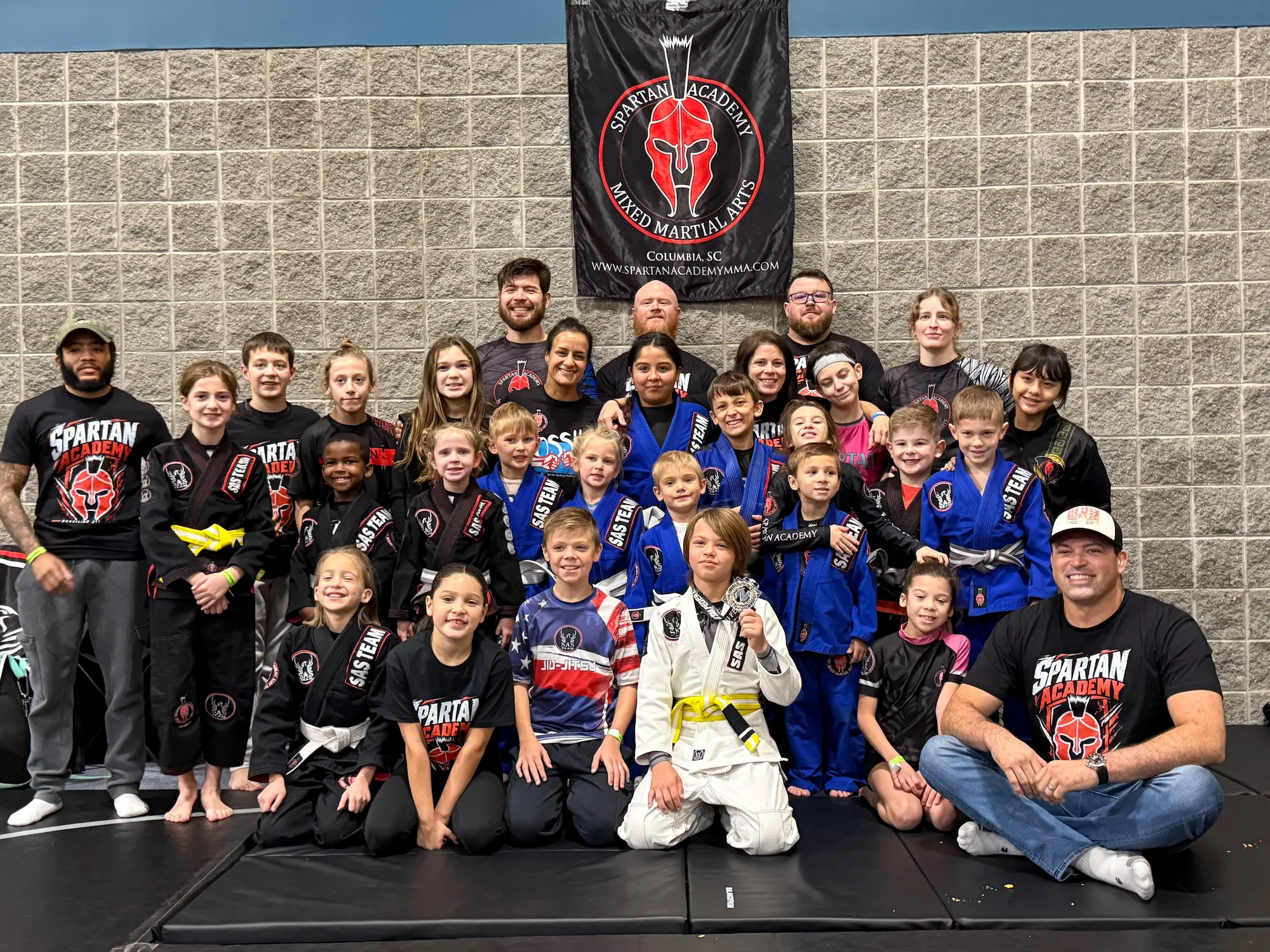
At Spartan Academy, younger teens train in our youth program, which covers ages 8 to 15. Classes are structured and high energy, with a real focus on doing things the right way.
The Youth Program (Ages 8 to 15)
The Youth Brazilian Jiu-Jitsu program is open to boys and girls, with or without experience. Students learn the fundamentals of BJJ, practical self-defense, and physical conditioning, then put it to work in controlled sparring.
Because the program spans ages 8 to 15, a teen will share the mat with some younger students. That can be a plus. Teens get to learn and help at the same time, and younger students often look up to them.
Respect is part of every class, not just the warm-up speech. As Professor Sá puts it, “Brazilian Jiu-Jitsu shapes future-ready adults.”
The Competition Path Is Optional
Some teens get hooked and want to test themselves in tournaments. Our Kids BJJ Competition Class for ages 7 to 15 is built for them. It sharpens competition technique and teaches students how to manage nerves and stay composed in a real match.
Competition is encouraged, never required. Many teens train just because they love it and never sign up for a tournament. Both paths are respected here.
Students who do compete train under a Head Professor who still competes himself. Professor Sá is an IBJJF Pan-American Champion and won the Master 2 Absolute division at the 2025 Pan No-Gi.
Adding Striking
Some teens want to learn to punch and kick, too. Spartan Academy also offers Youth Kickboxing for ages 8 to 15, so a teen can add striking without changing gyms.
Moving from the youth program into adult classes
Once teens age out of the youth program, they can keep training in our adult classes and build on everything they’ve learned. Ask our team how and when that move happens for your teen.
Our adult Brazilian Jiu-Jitsu program includes 60-minute classes with takedowns, submissions, escapes, and controlled sparring, plus No-Gi classes. A teen who has trained in the youth program walks in already knowing how class works, how to tap, and how to be a good partner.
If your teen is 16 or 17 and brand new to jiu-jitsu, talk with our team about whether our BJJ Fundamentals classes are the right place to start. We’ll help you pick a first class that fits their age and experience.
The jump to adult classes can feel big at first, and that’s normal. The best advice for a teen moving up is simple: partner with the experienced students during technique and ask a lot of questions.
Questions Parents and Teens Ask
These are the questions we hear most from families before a first class. If yours isn’t here, ask us when you book.
Does my teen need experience or to be in shape first?
No. Most students start with zero experience, and fitness comes from training, not before it. Classes build up the basics step by step.
Can teen girls train BJJ?
Yes. Our youth program is open to boys and girls. BJJ’s focus on leverage and technique makes it a great fit for girls who want real self-defense skills.
My teen is shy. Will they feel out of place?
Probably less than you think. Jiu-jitsu is done with one partner at a time, so nobody has to perform in front of a crowd. Many quiet teens find it easier to connect over a shared drill than over small talk.
How often should a teen train?
Many families start with two classes a week, which leaves room for school and homework. Our team can help you plan a schedule that fits your teen.
What should my teen wear to the first class?
Comfortable athletic clothes without zippers or buttons work for a first visit. Ask about uniform requirements when you book the free trial, and we’ll let you know what they’ll need going forward.
Is BJJ right for your teen?
If your teen needs a confidence boost or a sport where nobody gets cut, BJJ is worth a try. It doesn’t require experience. It just asks them to show up and keep learning.
At Spartan Academy MMA, teens train in the lineage of the Sá family, under Head Professor Guybson Sá, a 4th-degree black belt and son of Grand Master Francisco Sá.
And if you’re the teen reading this: you don’t have to be tough, fit, or experienced to walk in. You just have to try one class. The easiest way to know is to feel it for yourself, so book your teen’s free trial class at our Columbia, SC academy and come see what one hour on the mat can do.