
To choose a jiu-jitsu gym, visit during a beginner class and check five things: who actually teaches, whether there’s a real fundamentals program, how safe and clean the room is, how upper belts treat new people, and whether the schedule fits your week. A free trial class lets you check all of it before you commit. No experience is needed to start.
Key Takeaways
- The coach who teaches your class matters more than the name on the sign, so ask who that is and who promoted them.
- A real beginner path means a separate fundamentals class and sparring that starts slowly, with a coach watching.
- Use your free trial class as a test: watch the room, then ask questions after class.
- Walk away from gyms that hide their lineage, pressure you to sign early, or ignore taps.
You’ve searched “jiu-jitsu near me,” found a handful of gyms around Columbia, and they all say they’re beginner friendly. So how do you tell them apart?
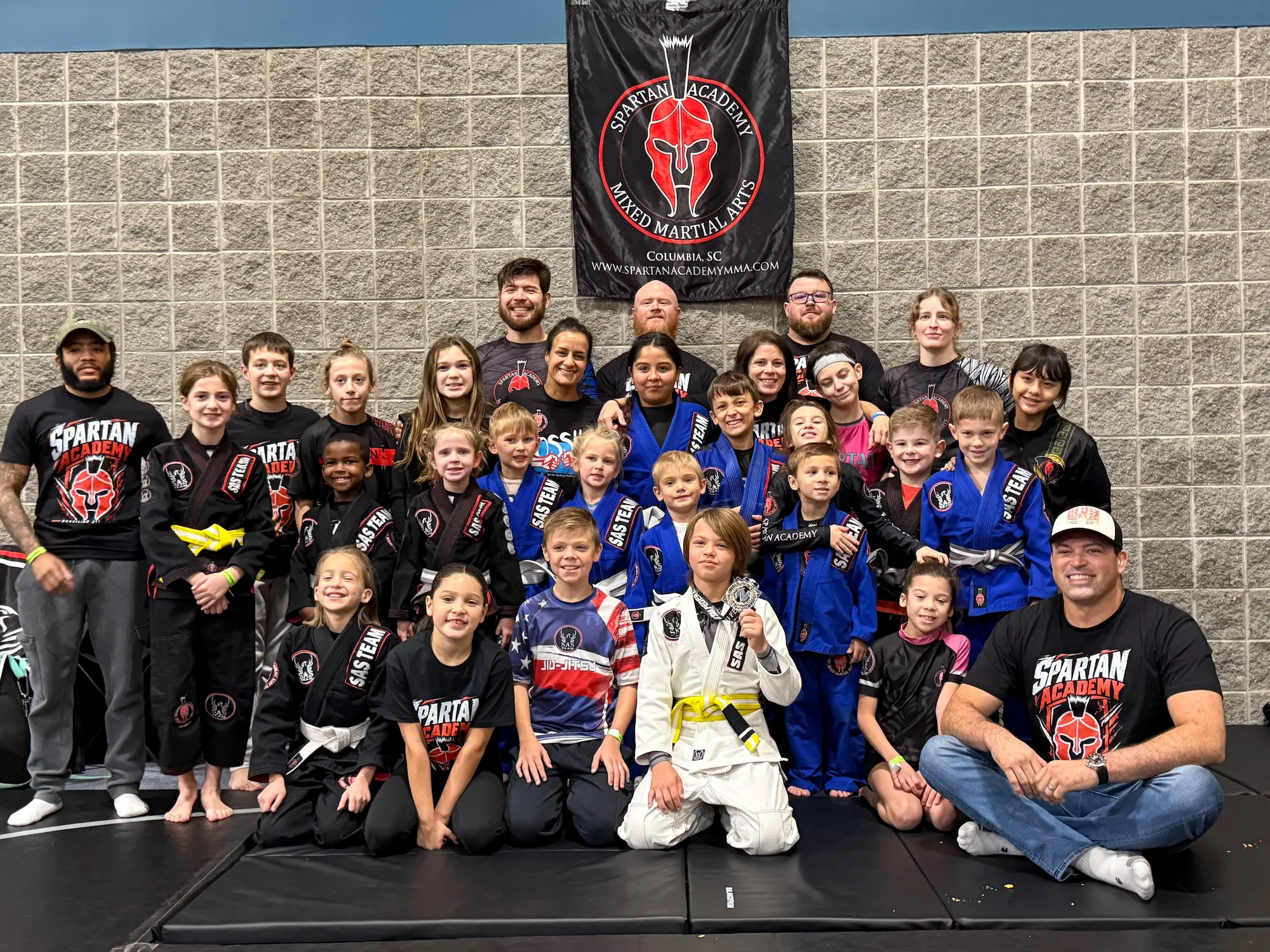
The gym you pick shapes almost everything about your first year on the mats. Here’s a simple checklist you can take to any gym, with Spartan Academy MMA as a real example of what good answers look like.

Start with why you want to train
Before you compare gyms, get clear on what you want out of jiu-jitsu. The right gym for a future competitor isn’t always the right gym for someone who wants to get in shape and feel safer walking to their car.
Most beginners fall into one or more of these groups:
- Fitness: you want a workout that doesn’t feel like a treadmill.
- Self-defense: you want to know you can handle yourself if something goes wrong.
- Competition: you want to test yourself in tournaments someday.
- Family: you want a place where your kids can train too.
There’s no wrong answer. Just write yours down, because it will make every other item on this list easier to judge.
Find out who actually teaches
The single biggest factor in how well you learn is the person teaching you. A good gym is happy to tell you exactly who that is and where their rank came from.
Ask Who Promoted the Head Instructor
There’s no single national license for jiu-jitsu instructors, so the belt on someone’s waist is only as good as the person who tied it. A real black belt will answer three simple questions without hesitation: what belt are you, who promoted you, and when?
Lineage is how BJJ keeps itself honest. Every legitimate black belt can trace their rank back through their teachers. At Spartan Academy, Head Professor Guybson Sá is a 4th-degree black belt, son of Grand Master Francisco Sá, and part of the SAS Team BJJ family. The academy’s History page lays out the full lineage chart, from Japan to Brazil to the mats in South Carolina. Any good gym should be able to explain its lineage just as clearly.
Check Who Teaches the Class You’ll Take
A famous name on the website doesn’t help if someone else runs every beginner class. The coach who matters most is the one teaching the class you’ll actually attend, so find out who that is and what belt they hold.
At Spartan Academy, the jiu-jitsu team includes Professor Sá and BJJ Coach John Sturgis, a black belt under Professor Sá. John was the first student to train under Professor Guybson from white belt all the way to black belt. You can read about the whole coaching team on the Instructors page before you ever walk in the door.
Look for a real beginner path
A good beginner gym has a clear plan for your first few months instead of throwing you into the deep end. Ask what that plan is, and listen for specifics.
A Separate Fundamentals Class
A good beginner program has its own class and a set curriculum, not just “show up and roll.” Beginners learn faster when the basics come in a logical order: how to fall, how to escape, how to hold a position, how to tap.
Spartan Academy’s BJJ Fundamentals program is built for adults with no jiu-jitsu experience at all. It covers essential techniques, self-defense, and foundational movement, and when you finish you move into the regular adult classes with a solid base.
How Live Rolling Is Introduced
Rolling (live sparring) is where jiu-jitsu clicks, but it shouldn’t come first. The answer to “When do new students start sparring?” tells you a lot about a gym.
A healthy answer sounds like: “after you learn the basics, with controlled rounds and a coach on the mat.” A worrying answer sounds like: “just jump in and you’ll figure it out.”
Brand new to jiu-jitsu?
Spartan Academy’s fundamentals class teaches the basics in order, so you can build confidence before you ever roll with the regular class. See how the BJJ Fundamentals class for adult beginners works
Use the free trial class as your test
A free trial class is the best research tool you have. Any gym that’s confident in its teaching should let you try a class before you sign anything.
What to Watch During Class
Get there a few minutes early and pay attention to the room, not just the technique:
- Does the coach explain each move clearly, then walk around and correct people?
- Are new students paired with someone patient, or left to figure it out?
- Do rounds look controlled, with partners matched by size and experience?
- Do people laugh and talk between rounds, or does it feel tense?
Questions to Ask After Class
Save your questions for after class, when coaches have time to talk:
- What should I focus on in my first month?
- How often do beginners usually train?
- Who do I ask when I’m stuck on a technique?
- What do I need to buy, and when?
- How often are the mats cleaned?
For a head start on those early weeks, our guide on how to get through your first month of BJJ covers the soreness, the confusion, and the small wins.
One trial won’t show you how fast you’ll improve, but it will tell you whether you want to come back. That’s the answer that matters most.
Your Gym Checklist at a Glance
Bring this table to every gym you visit. You can fill in each row from one class and a short chat afterward.
| What to check | A good sign | A red flag |
|---|---|---|
| Who teaches | The coach names their belt, who promoted them, and when | Vague answers or a defensive reaction |
| Your actual class | You know who teaches the beginner class you’ll attend | The head instructor is rarely on the mat |
| Beginner path | A separate fundamentals class with a set curriculum | “Just show up and roll” |
| Sparring | Controlled rounds after you learn the basics, with a coach watching | Hard sparring on day one |
| Hygiene | Clean, dry mats and no shoes on them | Dirty mats or changing areas |
| Culture | Upper belts slow down and help new people | Beginners treated like practice dummies |
| Sign-up | A free trial before you commit to anything | Pressure to sign before you finish a class |
| Schedule | Classes you can make two or three times a week | Beginner classes only at times you can’t attend |
Safety, cleanliness, and culture
Jiu-jitsu is close contact, so the room itself matters as much as the teaching. You want a place that’s clean, has clear rules, and where people help each other get better.
Clean Mats and Clear Rules
Look at the mats and the bathrooms. Mats should be clean and dry, with shoes kept off. Skin infections are a real risk in any grappling sport, and a gym that takes hygiene seriously usually takes everything else seriously too.
Clear rules matter just as much: tap early, let go the moment your partner taps, and expect coaches to step in if a round gets out of hand. Spartan’s adult jiu-jitsu classes use controlled sparring, and instructors are on the mat during open mat too. If injuries are your main worry, this honest look at whether jiu-jitsu is dangerous and how to lower the risks is worth a read before your first class.
How Upper Belts Treat New People
Watch how the upper belts act around beginners. In a healthy gym, experienced students slow down, explain things, and want the new person to come back.
If the upper belts treat beginners like practice dummies, keep looking. Ego is the fastest way to get hurt and the fastest way to quit.
At Spartan, Coach John Sturgis started helping lead classes back when he was a purple belt. That’s the kind of culture you want: people who learned on those mats turning around to help the next person in the door.
Gi, No-Gi, or both?
For most beginners, a gym that teaches both gi and No-Gi is the easiest choice, because you can try each style before you decide which one you like. Neither one is “better,” and plenty of students keep training both for years.
In the gi, you wear a heavy cotton uniform that both partners can grip. In No-Gi, you wear a rashguard and shorts, and the grips change to wrists, neck, and legs.
At Spartan Academy, the adult Brazilian Jiu-Jitsu program includes gi classes and dedicated No-Gi classes (a rashguard is required for No-Gi). When you book your trial, ask whether to bring a gi or just comfortable workout clothes.
If you’re choosing for your kids too
If your kids might train too, look for a gym with separate classes by age so the whole family can train under one roof.
Good kids programs have coaches who are patient with young children, and it’s fair to ask whether you can watch a class before signing your child up.
Spartan Academy runs Little Kids Brazilian Jiu-Jitsu for ages 4 to 7, which teaches balance, coordination, and listening through games and basic movements. Older kids move into Youth Brazilian Jiu-Jitsu for ages 8 to 15, with fundamentals, self-defense, and controlled sparring.
Make sure the schedule fits your real week
The best gym for you is one you can actually get to two or three times a week. Be honest about when you can show up: after work, after school pickup, or on weekends.
An open mat, a session where students practice and roll freely, is a nice bonus because it helps you catch up when you miss a class. Ask for the current class schedule during your visit and see what lines up with your week.
Red flags worth walking away from
Walk away from a gym that hides its lineage, pressures you to sign before you’ve trained, or throws beginners into hard sparring. Most gyms are run by good people, but take these signs seriously:
- The instructor won’t say who promoted them, or gets defensive when you ask.
- You’re pushed to sign up before you’ve finished a single class.
- New students are thrown into hard sparring on day one.
- Taps are ignored, or tapping is treated as weakness.
- The mats or changing areas are dirty.
- The head instructor is rarely on the mat.
One of these alone isn’t always a deal breaker. Two or three together usually mean you should keep looking.
How Spartan Academy answers the checklist
This checklist works at any gym, and you should hold every gym to it, including ours. If you train in the Midlands, here’s how Spartan Academy MMA in Columbia, SC, lines up:
- Who teaches: Head Professor Guybson Sá, a 4th-degree black belt who started training at age 4 in Brazil and moved to Columbia in 2009. He is an IBJJF Pan-American Champion, an IBJJF World No-Gi Champion, and won the Master 2 Absolute division at the 2025 Pan No-Gi.
- Beginner path: a dedicated Fundamentals program for adults with no experience, then regular classes.
- Safety: controlled sparring, instructors on the mat during open mat, and a fully insured academy.
- Culture: an open door policy, so beginners are welcome.
- Options: gi and No-Gi jiu-jitsu, kids and youth classes, and kickboxing under the same roof if you ever want to add striking.
You don’t have to take anyone’s word for it. Bring the checklist to your trial class and see for yourself.
Questions beginners ask before picking a gym
These are the questions new students and parents ask most often before they choose where to train.
How many gyms should I try before choosing?
Two or three is usually enough. Take a trial class at each, write down how you felt afterward, and compare them against your goals. If one room makes you excited to come back, that’s a strong sign.
Should I pick the closest gym or the best one?
Pick the best gym you can realistically reach two or three times a week. Distance matters more than people think, because the gym you get to consistently is the one that helps you most, but a few extra minutes of driving is worth it for better teaching and a safer room.
Do I need to be in shape before I start?
No. Jiu-jitsu gets you in shape, not the other way around. A good fundamentals class starts at a beginner’s pace and builds from there.
Is it OK to visit a gym if I’m nervous?
Absolutely. Almost everyone is nervous before their first class, including people who now have black belts. Tell the coach it’s your first time, and a good gym will pair you with a patient partner and make sure you leave feeling welcome.
What should I bring to a trial class?
Water, comfortable workout clothes without zippers or pockets, and flip-flops for walking off the mat. Ask when you book whether you need a gi. Trim your fingernails and toenails, and take off any jewelry before class.
Ready to put the checklist to work?
If you walk out of a trial class tired and already checking when you can come back, you’ve found your gym.
At Spartan Academy MMA, you’ll train under Head Professor Guybson Sá and a team built on the Sá family’s jiu-jitsu tradition. No experience is needed, and your first class is on us. Book your free BJJ trial class at Spartan Academy and bring this checklist with you.